
Guide
How to Prepare Your Prior Authorization Workflows for CMS-0057-F and Beyond
A five-part checklist and workflow mapping tool for patient access teams.
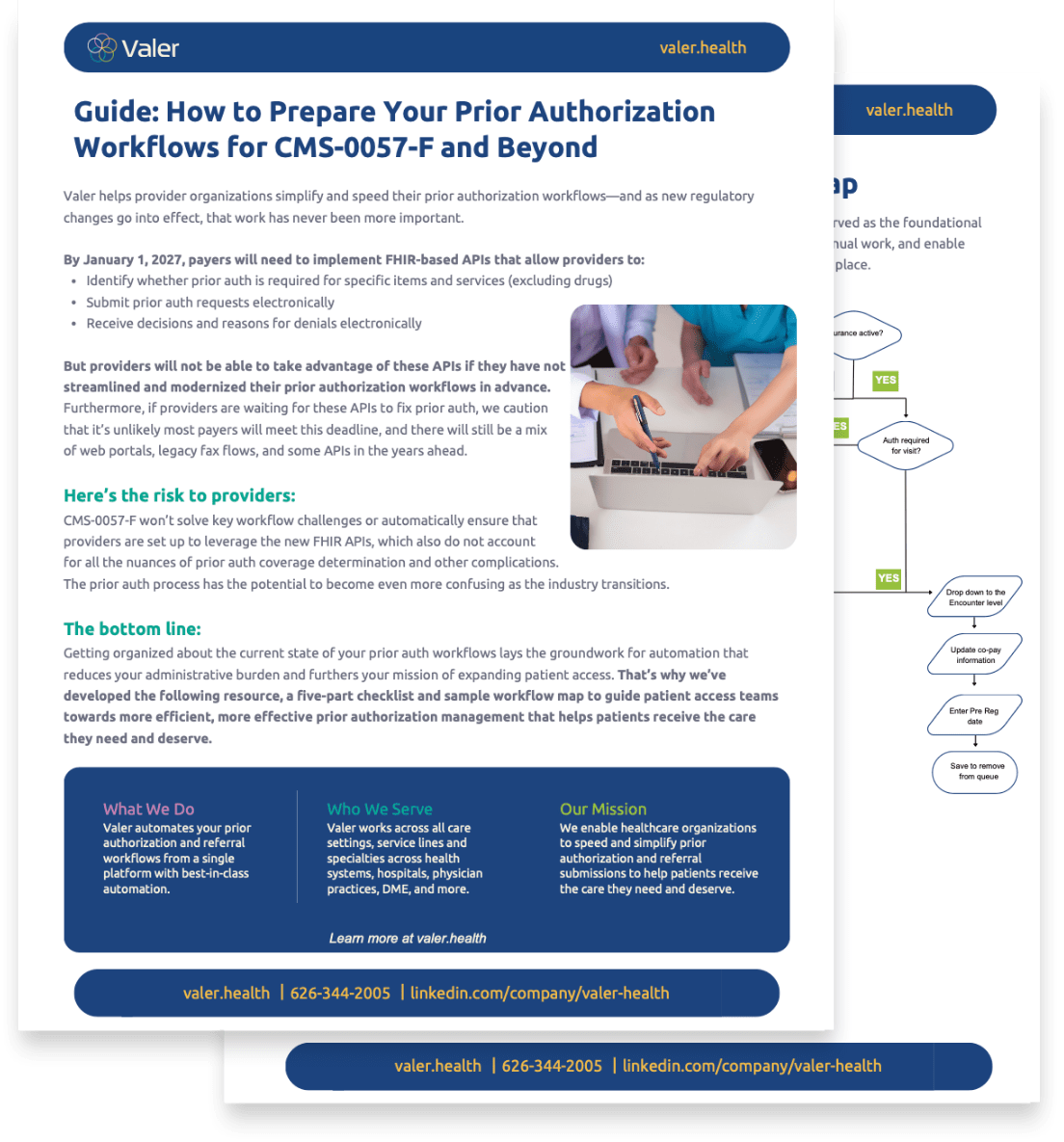

By January 1, 2027, payers must implement FHIR-based APIs that allow providers to:
- Identify whether prior auth is required
- Submit prior auth electronically
- Receive decisions and denial reasons electronically
But here’s the reality:
These new APIs won’t fix prior auth pain if your organization hasn’t solved fragmented workflows, disconnected teams, or manual EMR workarounds. Plus, realistically, most organizations will still be navigating a mix of portals, fax, and partial APIs for years to come. That’s why we recommend provider organizations control what they can and get organized.
If your workflows aren’t organized first, new APIs won’t deliver the efficiency gains you’re expecting.
That’s why we created this practical, five-part checklist and workflow mapping guide.
What’s Inside the Guide
This resource walks patient access leaders through a structured readiness assessment:

Centralization Opportunities
Identify where prior auth responsibilities are fragmented across teams and service lines — and where consolidation could improve efficiency and approval rates.

EMR Workflow Nuances
Document what happens inside vs. outside your EMR, uncover documentation gaps, and flag common data mismatches (NPIs, TINs, CPT capture, provider listings) that drive avoidable submission failures.

Granular Workflow Mapping
Map every submission step — across payers, business lines, delegated arrangements, and WISeR workflows — to pinpoint what can be standardized or automated.

Payer Reporting Readiness
Assess your ability to track turnaround times, approval/denial rates, and gold carding eligibility — without relying on inconsistent public reporting.

Staff Productivity & KPIs
Establish measurable benchmarks for prior auth volume, turnaround time, and training standardization to improve internal performance.


